
Is Your Plastic Product Still Yellowish Even After Adding Optical Brighteners Here is Why.
2026-03-31
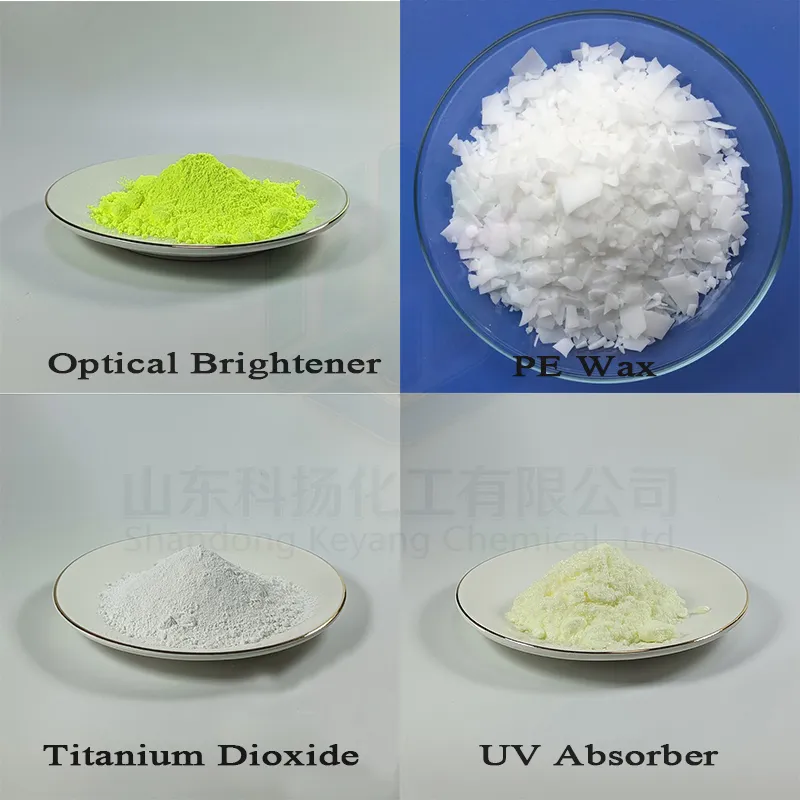
You’ve added Optical Brightening Agents (OBAs) to your plastic formulation, expecting that brilliant, "snow-white" finish. Yet, the result is a dull, yellow-white or gray-white product that misses the market standard.
This is a common frustration in the plastics industry. If your product isn’t whitening, it’s rarely the OBA "failing"—it’s usually a mismatch in chemistry.
Having trouble-shooted numerous production lines, I’ve found that the issue almost always falls into one of these three critical categories:
1️⃣ You Are Using the Wrong Type of OBA (The Compatibility Trap)
Not all fluorescent whitening agents are created equal. Using an OBA designed for PVC in a Polypropylene (PP) or Polyethylene (PE) system is like putting diesel in a petrol car.
The Science: Different polymers have different polarities and processing temperatures.
The Fix: Ensure you are using a high-temperature resistant OBA (like OB-1 or FP-127) for engineering plastics (ABS, PS, PC) and the correct dispersion type for polyolefins. The base resin dictates the OBA chemistry.
2️⃣ "More is Better" is a Dangerous Myth (The Concentration Quenching)
It is instinct to think that adding double the amount of brightener will yield double the brightness. In reality, it often does the opposite.
The Science: Fluorescent whitening agents work by absorbing UV light and re-emitting it as blue light. If you overload the system, the excess OBA particles actually absorb this blue light, creating a greenish or yellow cast.
The Fix: Stick to the optimal dosage range (usually 0.01% – 0.05% for most plastics). Beyond a certain saturation point, whiteness decreases.
3️⃣ Your "Base" is Too Dark (The Garbage In, Garbage Out Rule)
An optical brightener is a whitening agent, not a covering agent. Think of it as a highlighter pen—it makes white paper brighter, but it cannot turn black paper white.
The Science: OBAs add a fluorescent glow to mask yellowness. However, if your recycled resin or raw material has a naturally dark or yellow tint due to impurities or degradation, the OBA simply doesn't have a clean "white canvas" to work from.
The Fix: Evaluate your base resin quality. If the raw material is too yellow, you may need to combine the OBA with a toning pigment (like ultramarine blue) first, or switch to a cleaner resin source.
💡 Quick Tip: Always test the compatibility of your OBA with other additives like UV stabilizers or antimony trioxide, as they can sometimes "block" the fluorescence effect.
Have you ever faced this "whitening wall" in your production? Have you found out the main reason?Contact us to discuss together and find out the real reason.
#plastic #opticalbrightener #plasticadditive #oba #pvc #pe #pp #ABS #OpticalBrighteningAgent #ob1 #fp127